The Real Cost of a HELOC When Rates Rise (and How to Stress-Test Yours)
HELOC rates float with the Fed. Here's a simple stress test that shows what your payment actually looks like if Prime climbs two or three points — before you sign, not after.
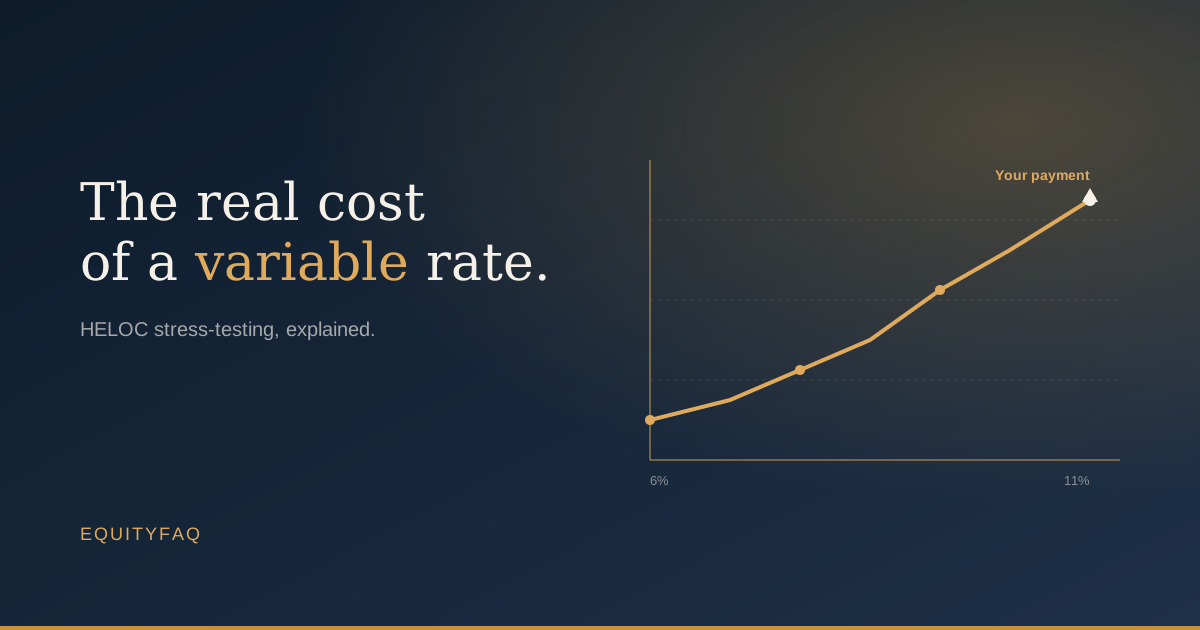
HELOCs are great until they aren’t. The thing nobody warns you about is that the rate you’re quoted at signing isn’t the rate you’re locked into. HELOCs are variable, tied to the Prime Rate, and Prime moves whenever the Federal Reserve decides to move it.
Between March 2022 and July 2023, Prime went from 3.25% to 8.50%. If you had a HELOC with a 1% margin over Prime, your rate went from 4.25% to 9.50% in sixteen months. That’s not a hypothetical — that happened to millions of homeowners.
The point of this post isn’t to scare you off HELOCs. They’re the right tool for a lot of situations. The point is to show you the 90 seconds of math you should do before you open one.
The anatomy of a HELOC rate
Your rate is almost always quoted as Prime + margin. Prime is the index, set by banks based on the Fed’s target rate. Margin is the lender’s markup, usually somewhere between 0.5% and 3%, based on your credit and loan-to-value.
Example: Prime is 8.5%, lender offers you “Prime + 1%.” Your rate is 9.5%.
If the Fed hikes next quarter and Prime moves to 9%, your rate becomes 10%. That happens automatically — there’s no renegotiation, no notice period beyond what’s in your disclosure.
Why interest-only payments make this sneakier
Most HELOCs are interest-only during the draw period. That’s great for affordability at signing, but it amplifies rate sensitivity.
Here’s the math. You borrow $50,000 at 8.5% (Prime of 7.5% + 1% margin):
- Interest-only monthly payment: $354
Now Prime climbs 2 points. Your rate is 10.5%:
- Interest-only monthly payment: $437
That’s +$83/mo on a $50K draw. Doesn’t sound catastrophic.
But remember: many people draw more than $50K during a renovation or consolidation. On a $125,000 balance, the same 2-point jump takes you from $885/mo to $1,094/mo. That’s +$209/mo, or +$2,508 a year. And that’s before any draw period ending and principal payments kicking in.
The three-scenario stress test
Before you open a HELOC, do this. It takes about two minutes.
Pull your proposed rate and your target draw amount. Say you plan to draw $80,000 at a 9% rate.
Scenario 1 — No change. Your monthly interest-only payment: (80,000 × 9%) ÷ 12 = $600/mo
Scenario 2 — Prime rises 2 points. Rate becomes 11%: (80,000 × 11%) ÷ 12 = $733/mo
Scenario 3 — Prime rises 3 points. Rate becomes 12%: (80,000 × 12%) ÷ 12 = $800/mo
Now ask yourself: can I comfortably pay $800/mo? If the answer is “yes without a thought,” you’re fine. If the answer is “maybe, if nothing else goes wrong,” you’re borrowing too much or picking the wrong product.
Three ways to reduce HELOC rate risk
If the stress test scared you a little, you have options.
1. Borrow less. Obvious but often ignored. Cut your target draw by 20-30% and the worst-case scenario gets much less scary.
2. Use a fixed-rate conversion option. Many HELOCs let you “lock in” a portion of your balance at a fixed rate at the current market level. It’s a one-way door — you usually can’t unlock — but it caps risk on whatever chunk you’re certain about.
3. Choose a home equity loan instead. If you know you’ll draw close to the full amount, a fixed-rate home equity loan might beat a HELOC on total cost of risk, even if the quoted rate is slightly higher. Certainty has a price, but it’s a price you pay once.
The “it can also go down” counterargument
Fair point. Variable rates cut both ways. If Prime falls 2 points, your payment drops right along with it. Historically, rates rise slower than they fall, so a HELOC’s downside benefit from cuts has been pretty real.
Just don’t bet the farm on it. Plan your budget around the worst-case scenario. If cuts come, they’re a bonus.
A quick sanity check the day you sign
Ask the loan officer two specific questions:
- “Is there a lifetime rate cap?” Most HELOCs have one — often 18%. That’s the absolute ceiling. Nice to know but not comforting at the payment level.
- “Does my rate reset monthly, quarterly, or annually?” Monthly is the most common. It means you don’t have much cushion if Prime moves fast.
The answers don’t change whether you should sign, but they tell you how much time you’d have to react if rates climbed.
Rate alerts via SMS sign up here. We’ll let you know when Prime moves or when new fixed-rate options hit the market.