HELOC, Home Equity Loan, or Cash-Out Refi? A Homeowner's Decision Guide
Three ways to tap your home's equity, compared the way a friend in the business would actually explain them — with real numbers, tradeoffs, and when each one makes sense.
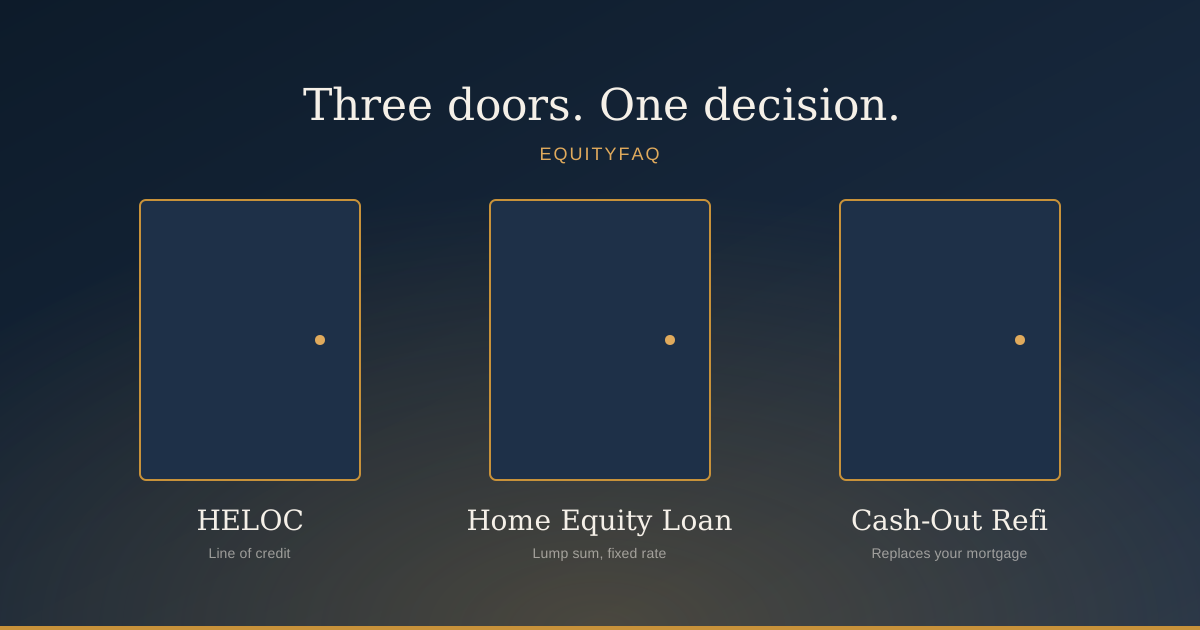
If you own a home and you’ve been paying on it for a while, you probably have more borrowing power sitting in your walls than you realize. The question is which way to unlock it.
Most articles online list features like they’re comparing phone plans. That’s not how the decision actually plays out. The right product depends on how much you need, whether you need it all at once, and what your current mortgage looks like. Let’s walk through the three realistic options the way a friend in the business would explain them.
The short version
- HELOC — a credit line you draw from as needed. Variable rate. Best when you want flexibility, or you’re not sure how much you’ll actually spend.
- Home Equity Loan — a one-time lump sum at a fixed rate. Best when you know exactly what you need and want a predictable payment.
- Cash-Out Refinance — replaces your entire mortgage with a new, larger one. Best when your existing mortgage rate is already close to today’s market rate, and you need a large amount of cash.
If your current mortgage is locked at 3% from 2021, don’t refinance. More on that below.
HELOC: the credit card version of a home loan
A HELOC gives you a credit line — let’s say $75,000 — that you can draw from over a “draw period,” typically ten years. During the draw period you usually pay interest only on what you’ve borrowed. After that, you enter the “repayment period” (another 10–20 years) where you pay down both principal and interest.
Two things to know:
- The rate is variable. It’s tied to the Prime Rate plus a margin. If the Fed hikes, your payment goes up. If you borrowed $50,000 at 8.5% and Prime jumps two points, your interest-only payment goes from about $354/mo to $437/mo.
- You only pay interest on what you draw. If you open a $75,000 line and only use $12,000, you’re paying interest on $12,000. That’s why HELOCs are great for unpredictable projects — renovations that might come in under or over budget, for example.
A HELOC is the right tool when you want optionality. You’re not committing to borrow the full amount. You can open it, sit on it, and only tap it when something actually comes up.
Home Equity Loan: the one-and-done option
A home equity loan is simpler. You borrow a fixed amount at a fixed rate over a fixed term (usually 5 to 30 years). You get the whole amount as a lump sum and start paying principal and interest from month one. It’s sometimes called a “second mortgage” because that’s literally what it is.
When does this beat a HELOC?
- You know the exact number. A $45,000 kitchen remodel with an itemized bid, or a $30,000 tuition payment due in August.
- You want payment certainty. Rate locked, payment locked, done.
- You’re uneasy about rate risk. A fixed rate means the Fed’s next move doesn’t change your life.
The tradeoff: you start paying interest on the full balance immediately, even if you don’t end up spending it all at once.
Cash-Out Refinance: the nuclear option
A cash-out refi replaces your existing mortgage entirely. You take out a new, bigger loan and walk away with the difference in cash. If your home is worth $500,000 and you owe $200,000, you might refinance into a new $350,000 mortgage and receive $150,000 in cash at closing.
Here’s the thing almost every article glosses over: you’re not just borrowing the cash-out amount. You’re re-pricing your entire mortgage at today’s rate.
Let’s say you have a $200,000 balance at 3.25% (a 2021 special). If today’s rate is 7%, refinancing to pull out $50,000 means your remaining $200,000 also jumps from 3.25% to 7%. That rate increase costs more over time than the $50,000 is worth.
Cash-out refi makes sense when:
- Your current mortgage rate is already at or above today’s market rate.
- You need a large amount of cash — typically $75,000 or more.
- You want to roll the new borrowing into one payment instead of managing a second loan.
If your existing mortgage is sub-5% and today’s rates are north of 6.5%, a HELOC or home equity loan is almost always better. You preserve the cheap first mortgage and only pay the higher rate on the new money.
A quick decision framework
Ask yourself three questions:
1. How much do I need? Under $50K → home equity loan or HELOC. Over $100K → any of the three; cash-out becomes more viable at scale.
2. Do I know the exact amount, or is it open-ended? Exact → home equity loan. Open-ended (renovation, business, tuition over several years) → HELOC.
3. What’s my current mortgage rate? Below today’s market rate → HELOC or home equity loan. Don’t touch the first mortgage. At or above today’s market → cash-out refi is on the table.
One more thing: all three use your house as collateral
This gets lost in the rate comparisons. All three of these are secured loans. If you stop paying, the bank can foreclose — same as your mortgage. Equity products are not personal loans with a different sticker. Borrow what you can repay even if your income changes, and leave yourself margin for rate increases on variable products.
The upside is that because they’re secured, rates are dramatically lower than credit cards or personal loans. The downside is that the stakes are your house.
Want rate updates and new posts like this delivered to your phone? Sign up for free SMS alerts. We only text when something actually moves.